All Local Authorities are required to have an up-to-date Local Plan which establishes the framework for future development, guiding decisions on where and what can be built considering local needs and opportunities.
Ealing’s existing Plan is the oldest in London. Adopted by the Council in 2012 it covers the period 2011 to 2026. Taking over six years to produce, Ealing Council has published a new draft Local Plan for the period 2024 – 2039.
This is a series of blogs covering the still ongoing public examination of Ealing’s proposed new Local Plan which started on 16 June 2025. The main author and editor of the blogs is Eric Leach – for 20 years WEN’s Vice Chair.
Click on any of the blog issues (below) for details.
06/05/2026 – Blog Issue 18 – Local Plan 2024 – 2039
In just 6 weeks time it will be 12 months since Government Inspectors began reviewing Ealing’s draft Local Plan 2024 – 2039 (on 16 June 2025). Given that Ealing Council began work on this plan in 2019, the combined incompetence of Council Planners and Government Inspectors is plain to see. How can anyone have any confidence whatsoever in local and national planning processes if this debacle is endemic across the other 316 Local Authorities in England.
Eric Leach
16/12/2025 – Blog Issue 17 – Detailed review of various sites; final assessment of the hearings
A supplemental blog written by Save Ealing’s Centre chair Will French, who attended much of yesterday afternoon’s session
Below is my take away from the discussions on individual sites in the Metropolitan Town Centre (MTC). We began in much detail with the 01EA – the old Glenkerrin site but then accelerated to cover the rest of the sites in the MTC in no time at all.
First, however, Ealing has published a New Metropolitan Town Centre Growth strategy, which looks only at the centre’s commercial prospects and omits reference to other town centre uses, community uses etc. There has been absolutely no public engagement or consultation regarding this and it contains no reference to the other roles the town centre ought to be playing.
Unfortunately, the message coming out of the examination is that commercial users no longer want to come here. There is no demand for large scale office uses – only for Small and Medium sized Enterprises (SMEs). Because of this, none of the commercial schemes are going ahead.
It looks to me as if Ealing’s chickens are coming home to roost now. Having abandoned any sense of leadership in the evolution of the town centre, preferring, instead, to hand decision making entirely to private developers, they are discovering these latter are not playing ball. They are realising that in the current climate, there is nothing here to make it worth their while to invest.
Never mind, LBE is leaping into action. They are to prepare another statement about demand for offices and how best to accommodate it.
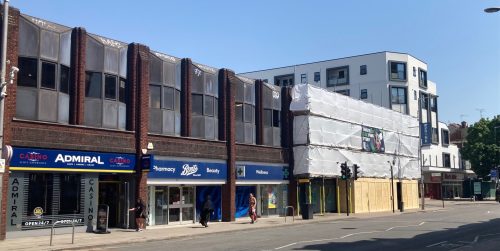
- Arcadia site (across the road from Ealing Broadway Station)
Now being discussed for redevelopment with an outfit called Investra Capital. Our good friends, Savills are representing them and submitted a statement to the Examination. You can read here. Savills tell us that ‘Investra is a bespoke real estate advisor who strives to make long-term improvements to the local surroundings in the areas in which they work, with emphasis placed on the well-being of the local community.‘ In other words it looks as if they are from the same stable as Benson Elliott (a previous owner who took a big profit by selling on the site).
It is unclear just what Investra Capital’s present interest in the land is. They are primarily concerned with the western half of the old Glenkerrin site (TK Maxx and Morrisons) which they caused to be merged into British Land’s (BL’s) ‘Broadway Connection’ site on the eastern half. It seems Investra have gone into partnership with BL now BL are not proceeding with their office development. So the overall intention seems to be to redevelop the whole site.
At the examination, Investra’s main concerns with the site proposals were to:
- Maximise height and bulk appropriate to the development
- Secure a more flexible use mix than ‘office’ use – probably involving other employment and Large-scale Purpose-built Shared Living (LSPBSL).
Historic England who have been present throughout this part of the examination have raised concerns about potential height and density. I think they are quite good. They flag the absence of a ‘cluster study’ similar to those that have been done for other sites ‘suitable for tall buildings’ across the Borough. LBE’s Sam Cuthbert justified this on the grounds they had already done a lot work in this area so didn’t need another one.
- Ealing Broadway Centre (EBC)
We were told that the EBC Site has come up in response to a request by British Land, the landowners. I presume this is to assist in their programme to disinvest from Ealing. Councillor Jon Ball and I spoke against redevelopment, noting that this at least is one part of the Town Centre which seems to be performing successfully.
- CP House’s current consent (2022) is too large to implement. So they are seeking a mixed use scheme, which might include offices, but also other ‘complementary town centre’ uses – eg LSPBSL.
The existing consent is coming up for expiry.
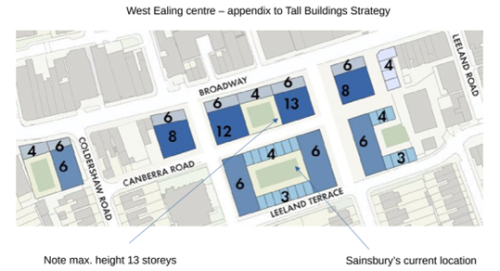
- Sainsbury’s & Library, Melbourne Avenue, off Broadway, W13. Development is currently scheduled in the plan for implementation in the second half of the plan period, reflecting the present difficult market conditions. However, it could be brought forward if there is a master planning exercise between adjoining landowners and LBE.
- Chignell Place off Broadway, W13. Inspector wants to know if a master planning approach would be appropriate. LBE answering no because of existing consents.
- Western Gateway, 131-141 Broadway, W13. Should there be master planning here? LBE say no due to the extant consent and development underway.
- Waitrose, Alexandra Road, W13
Much confusion on behalf of the Inspector. Owners John Lewis & Partners (JLP) saying that they want a s.106 (mandatory developer tax) for Jacob’s ladder. Issues of viability which LBE’s Steve Barton suggests arise from Waitrose having gone for an expensive development.
JLP want to include relaxation of parking standards for the supermarket, so as not to forbid it. Suggestion is that the scheme becomes unviable.
[Strong evidence from JLP that JLP is considering a new Planning Application to add more flats possibly up to 20 storeys. JLP meeting with local residents on 18 December – Eric Leach].
Will French
Examination postscript
This constitutes my final blog on the examination which (incredibly) began on 16 June 2025.
I sat in on most of it. There are two more days of it (17 and 18 December) but they cover non West Ealing sites and I have no real input on these.
I have to be honest and state I was not impressed by the Inspectors or the exam process. To allow Ealing citizens and land owners to participate is acceptable to me. But I would exclude property developers, speculators and lawyers.
Online examination, if this one is typical, is unfit for purpose. Sound quality varied from good to awful. Some citizens tried many times but could not access the online sessions.
No doubt Ealing Council will have lots of homework to do in January 2026 to satisfy the Inspectors’ most recent information requests. An approved new Local Plan will probably see the light of day in mid-2026.
We need an up to date Local Plan otherwise property owners, speculators, developers and lawyers will run Ealing Council and our precious Ealing environment ragged.
If the Government and developers get their way 15,000 new homes will be built in Ealing by April 2029. If these buildings are largely tower blocks then in less than 5 years’ time between 150 and 200 new residential tower blocks will dominate Ealing’s skyline.
Merry Christmas!
Eric Leach
16/12/2025 – Blog Issue 16 – The plan’s failure to indicate the number of homes on new sites; Savills wanting the Waitrose development to be even higher and to ignore the Jacob’s Ladder issue
Matter 9: Development sites
We spent over two hours going round in circles mostly about building heights policies and procedures. Developers piled in wanting higher residential towers to optimise the use of land. Ealing’s Sam Cuthbert was asked many different times and in many different ways how Ealing could change the allocated/approved height of proposed new buildings. His answers were difficult to understand and most unconvincing.
Inspector Dillon again brought up the issue that no number of homes (even an ‘indicative’ number) were identified in any of the Development Sites. She was again unhappy with the answers given by Ealing. Why couldn’t she just TELL EALING TO DO IT!!!!
Will French was concerned about Ealing’s strategy for Ealing Town Centre. He found out such a document existed and Ealing recently sent him a copy. He said it was not a strategic assessment but an economic one. Will said such a strategy needs to be drafted and Ealing’s residents given a chance to review it.
Savills – a leading real estate consultancy representing JLP/Waitrose – waded in twice in the morning – one with a legal hat on and one with a planning consultant hat on. It became common knowledge yesterday that Savills had convinced JLP/Waitrose to submit a new Waitrose West Ealing planning application for taller towers, challenging the car-free aspect and dropping any reference to Jacob’s Ladder. Local residents will be furious at this. JLP’s recent constructive engagement with local residents is now under threat.
I got the chance to speak. I said I was quite surprised that one of the explicit infrastructure topics to be examined was not transport. I pointed out that significant numbers of London commuters could currently not get on the morning rush hour Elizabeth Line trains at West Ealing station. The trains are arriving completely full. This situation will get worse when 2,000+ new residents move into the tower blocks in Manor Road, Hastings Road and Alexandra Road (Waitrose). To make matters worse, 12,000+ new residents were expected in Southall and Hayes. Morning rush hour commuters would then struggle to board an Elizabeth Line train at all five Ealing Elizabeth Line stations. Ealing Council responded by saying TfL had promised more morning rush hour trains stopping at West Ealing in 2027.
We broke for lunch at 12.10pm – not even having begun to review the Ealing/West Ealing development sites. After lunch my MS Teams link collapsed and after two failed attempts to get back online I abandoned the online exam.
Eric Leach
11/12/2025 – Blog Issue 15 – Lack of congruence between objectives and policies; failure to predict future homes in the seven towns
Town Plans
The following notes are courtesy of Ealing Matters’ Kay Garmeson.
Councillor Jon Ball questioned the division of the borough into seven towns as a somewhat arbitrary political concept driven by the perception that Central Ealing is too dominant, and that there is a need to construct a set of equal blocks across the borough. He disagreed that each had a strong local identity, in particular the larger towns, eg. Ealing and Acton. He saw no evidence for such a split. SEC’s Will French commented that the Plan seems to have moved away from the hierarchy that has always been used to categorise town centres, and their distinct roles. In particular he felt that town centres are not just for housing development and economic activity. They are also for the community and the Plan needs to be strengthened to deliver this. Ealing’s Steve Barton disagreed saying that the Plan sought to reimagine town centres and that the aspiration for community uses is included in that.
Will French questioned Ealing’s status as a Metropolitan Town Centre (MTC) on the basis that it is losing its sub-regional role. He wanted a much clearer strategy for what the town centre would be like in ten years’ time. Steve Barton emphatically refuted this using an Ealing MTC strategy document as evidence. This had not yet been uploaded to the evidence base, and there has been no public consultation on it.
Both Inspectors questioned the relationship between objectives and policies in the town plans and hence their effectiveness. Specifically:
- it is not always clear how policies support the related objective. As an example, Policy S1: Southall Spatial Strategy (p384) item A says that ‘future development and investment in Southall will celebrate and strengthen the unique character and heritage of Southall’ but it was not clear how that would be achieved.
- the policies cover a mix of topics, some with a direct effect on development management and others not.
- wordings do not read as policy, leaving it unclear to developers what the Council’s expectations of them are, which could leave decisions open to appeal. Policy G2: Greenford District Centre was cited as an example.
The Inspectors were critical of the fact that the town plans did not include the numbers of homes slated for each town as the aim of the town plans was to give transparency to local people about how they will change. Ealing Council’s Ian Weake was resistant, saying that a breakdown is already provided within the housing trajectory, but that these figures reflect a snapshot in time and are subject to change, and should therefore not be included in the Plan. Inspector Dillon argued that there is a need to have a baseline for assessment when the Plan is adopted in order to monitor its effectiveness. She didn’t understand why the Council didn’t want to include the snapshot from the trajectory in the Plan. She wanted to return to this under the matter dealing with monitoring.
10/12/2025 – Blog Issue 14 – Open space; climate change
We began today with Matter 7, ‘Climate Change’. Mentions of ‘Net Zero’, ‘carbon free’ and ‘embedded carbon costs’ were little in evidence.
Open Space
Inspector Dillon spent 1.5 hours exploring all the many planning nuances of open space. I thought a real discussion might take place when Nic Ferriday of Friends of the Earth brought up the Gurnell Leisure Centre planning permission for residential tower blocks on Metropolitan Open Land. He famously said the ‘ancillary use’ should not just be about developers making money. Alice Roberts of CPRE made the same point and referred to the Old Actonians proposal. Ms Dillon however kicked the issue into the long grass. MS Dillon did question why Ealing could not just accept The London Plan’s (TLP’s) policies on Climate Change, with no local variations.
Ealing Matters’ Libby Kemp pleaded for open land on the site of new, large residential developments – and if offsite open land was the only land on offer the Planning Application should fail. No response from the Inspector.
There was much talk about the ‘visual impact re openness’. Anne Denby of the Canals & Rivers Trust was not completely happy with what Ealing had put in the plan. Then we got into ‘openness tests’ and ‘auditory openness’.
Biodiversity and Access to Nature
Variation from The London Plan was raised as an issue.
Then an echo developed on all speakers’ contributions. I could not decipher what folks were saying and bailed out of the online exam at 12:28pm.
I can’t help but feel that this examination is a huge waste of time and money. It does not help that the examination is so discontinuous – it actually started 177 days ago! Block 1 was acceptably face-to-face but Block 2, which started on 2 December, has been online and fraught with technical and hearing problems. The spatial futures for 360,000 residents over 21 square miles for 15 years is being examined here – using online MS Teams is just not good enough.
I can’t, sadly, take any comfort from how the current Ealing Local Plan (2011 – 2026) has been consistently ignored by Ealing Council when determining large residential developments.
As for Housing Minister Steve Reed’s ‘Build, build, build’ (1.5 million) directive, one has to be persuaded that the Planning Inspectorate in Bristol has been ordered to remove as many ‘obstacles’ to housing developments as possible.
Are Inspector Dillon’s long drawn out preoccupations with somewhat fringe issues like travellers, gypsies and auditory openness merely a tactic to eat up the time and give the impression of ‘thoroughness’? I think they are.
Eric Leach
09/12/2025 – Blog Issue 13 – Tall buildings and preservation of character; lack of clarity
MS Teams would not let me on the system until Ealing’s Local Plan Programme Manager used a special code to get me in, 38 minutes into the examination. The first phrase I heard was ‘sensitivity analysis’.
Tall Buildings
These were apparently being discussed, with Ealing’s Samuel Cuthbert doing most of the talking. His quiet, unemotional, monotonal Scottish lilt made deciphering what he was saying quite difficult. The Inspector wanted to know whether developers had been involved in policy formation, design analysis, and was there any flexibility on tower block heights? Ealing’s answers were somewhat underwhelming. The Inspector wanted someone to explain how building heights related to capacity of sites. Ealing’s Ian Weakes unconvincingly mumbled his way through some sort of answer.
More Inspector questions including how does the evidence translate into policy, impact testing, and what exactly are exceptional circumstances? It became clear that the Inspector was not receiving the clarity he wanted and began asking Ealing to re-write certain policies. This became a feature of today’s examination.
Kim Mellor of Historic England pointed out an absence of guidance on tall buildings on industrial sites. Again the phrase ‘lack of clarity’ kept cropping up.
Ealing Matters’ Libby Kemp got stuck in by saying all these tall buildings proposed in Acton, Southall and West Ealing had hardly any open space and would have a major impact on people’s lives.
Alexander Booth KC complained of lack of clarity in the tall buildings policy. He said it was inflexible and unjustified. The object, he said was to maximise the number of delivered homes.
Henry Peterson of Old Oak Neighbourhood Forum queried the excessive floor height of 3.5 metres for residential properties. Using the terms ‘sites’ and ‘locations’ was also confusing. Measuring tall buildings by floors was confusing.
Councillor Jon Ball said local residents were alienated by very tall buildings eg. the 55 storey tower in Acton. Ealing is a suburb and this kind of height is not appropriate and is changing the character of the borough. The higher the tower the greater the carbon costs and excessively tall buildings were not consistent with Ealing’s Net Zero policies.
Kay Garmeson of Ealing Matters said Ealing’s tall building policies were confused and at odds with The London Plan and the Allies and Morrison proposals on the subject. Tall buildings should only be allowed in designated areas, she said.
Will French of SEC added that 6 storeys or more seemed like the borough-wide policy being proposed. The recent successful appeal by JLP on the proposed Waitrose development potentially drove a coach and horses through the new Local Plan tall buildings policy.
A developer raised the issue of Arcadia and Ealing town centre tall buildings policy. He pleaded for taller buildings so that the full potential of sites could be realised and contribute to Ealing’s very high annual housing targets.
Geoff Payne of Creffield Area Residents Association pleaded that building heights should be appropriate. He also said the carbon impact of tall buildings undermined the borough’s Net Zero targets. Finally, families with young families needing houses were having to leave Ealing to find suitable accommodation. The new Local Plan offered no likelihood of improving this situation.
Many developers then piled in wanting taller residential tower blocks. Over and over again the Inspector said Ealing’s policies were confusing/not clear enough and asked for some of them to be re-worded.
Historic Environment
The new Local Plan has no historic environment policies. Ealing’s Cuthbert said this was because such policies are in The London Plan.
At 12:56 MS Teams shut down the online examination without any sort of warning.
Eric Leach
02/12/2025 – Blog Issue 12 – Housing land supply; student accommodation vs. what is needed
Before we get into details of what happened today – day 1 of Block 2 – some catch up information is required.
Since June 2025, a huge number of documents have appeared (unheralded) on the Council’s Local Plan web site. Some are new documents and some are old documents made public for the first time. One useful snippet of new information is that unlike in recent years the Council now claims it has a Five Year Land Supply figure (a statutory requirement). Wow – the next thing that could happen is that the Council will produce annual housing completion figures. What a novelty that would be.
New Government housing targets for Ealing should have been confirmed recently. The figure will be around 3,000 completions annually up to 2029. No-one in their right mind believes these targets are remotely achievable. In West Ealing, for example, we have 10 major residential sites with Planning Permission, but construction is only taking place on one of the sites – the ‘infernal’ tower next to West Ealing Station.
As part of the Government’s ‘build, build, build’ obsession to complete 1.5 million new homes by 2029, all Local Authorities must create new Local Plans. So not only has the Council to complete the new Local Plan by mid-2026, it must begin work on a new, new Local Plan to attempt to complete 3,000 new homes every year till 2029.
And so onto today’s examination highlights. The topic – the elephant in the room – housing.
Things quickly turned surreal and frankly appalling as Inspector Dillon allowed gyrations around the Gypsy and Traveller policies to last 77 minutes. This was in addition to the 45 minutes pirouetting around the topic in Block 1 in June. Surely this was delinquent behaviour on behalf of the Planning Inspector
Then we got onto the Five Year Land Supply issue. Council Officer Weake ‘erred’ and ‘you knowed’ for an age on the somewhat arcane approach LBE had used. Somewhat anonymous developers and consultants demanded numbers of residents on each planned residential development. Mr Weake effectively said no. Ealing Matters’ Kay Garmeson pointed out that with Planning permission for 20,000 new homes already existing in Ealing the whole new-homes-to-be-built exercise was much like flogging a dead horse.
We eventually got onto speciality housing or ‘co-living’ and student accommodation in normal language. LBE claimed they were needed to complete its range of short term accommodation offerings. Will French from SEC said they were not really appropriate in the Ealing Metropolitan Town Centre. Councillor Jon Ball asserted that co-living and student accommodation were just approaches to avoid providing social housing. Resident Sue New said she felt co-living developments would inevitably morph into hotels.
Purpose Built Housing (PBH) was brought up next. Apparently the huge Greystar Greenford Quays build-to-rent residential development is PBH. Its representative claimed LBE sees no need for PBH.
Specialist Housing was next on the agenda and a lady from the Planning Reform Action Group (PRAG) was allowed by Inspector Dillon to talk at great length about LBE not meeting the housing needs of people with key protected characteristics. Ms Dillon tried to tell her that this was taking us all beyond plan making. This did not deter the PRAG lady who fiercely said unsafe homes were completely unacceptable, and this was a planning issue. There was break at 2:20pm. I’d had enough and left the meeting for a late lunch.
Eric Leach
31/07/2025 – Blog Issue 11 – Ealing Council asks to postpone the Block 2 hearings
On 31 July 2025 we detected a 25 July 2025 Ealing Council reply to the Government Inspectors’ ‘additional work required’ missive.
Instead of the Council’s email bearing meaningful content, it quoted ‘prebooked holiday of key members of the team’ as a reason for not meeting the response deadline specified by the Planning Inspectors. The Council now wants to cancel the Block 2 examination hearings (9 – 18 September 2025). The Council’s ‘intention’ is to complete the work required by mid-October 2025.
Massively unimpressive.
30/07/2025 – Blog Issue 10 – Doubt whether the second tranche of examination will start on schedule
On 11 July 2025 the Government’s Planning Inspectorate wrote to LBE detailing 23 issues it needed LBE to respond to. It wanted a reply by 18 July 2025.
As of 28 July 2025, no reply from LBE has been published in the LBE examination web site.
This delay (refusal) by LBE to meet the Government’s needs will surely not endear it to the Inspectors. It also calls into doubt whether the second half of the examination (‘Block 2’) will actually commence on 10 September 2025.
Eric Leach
16/07/2025 – Blog Issue 9 – Inspectors’ surprising statements
Letter sent to Ealing Local Plan Programme Officer:
On 18 June 2025 Government Inspector Carol Dillon in answer to queries raised by residents Sue New and Kay Garmeson about social housing stated ‘it is not the role of the Local Plan to determine and meet social housing needs’. The lack of social housing in Ealing and in other Local Authorities is a massive problem. If what Ms Dillon says is true, then quite what is the point of a Local Plan? Please point me to the Government legislation which underpins her statement.
On 17 June 2025 during discussions on infrastructure Inspector Dillon asked what the Ealing Clinical Commissioning Group had to say on the matter. I was stunned by this. All NHS CCG throughout England were closed down on 1 July 2022. I find it hard to have confidence in this examiner’s judgements on healthcare infrastructure capacity planning in Ealing if she is clearly unaware of the current NHS governance structure in Ealing. An explanation / apology would be appreciated in the September 2025 examination sessions.
Eric Leach
10/07/2025 – Blog Issue 8 – Examiners request much more data from Ealing Council
On 3 July 2025 the Government examiners wrote to LBE requesting further actions and information. The topic areas are Duty to Cooperate, infrastructure, Housing Land Supply, Gypsies & Travellers, strategic policies and Policy E3 – Affordable workspace.
The Government’s letter to LBE can be downloaded here:
Letter_to_Council___Post_hearings_advice__acc5 Download
10/07/2025 – Blog Issue 7 – John Lewis and Berkeley Group press for more
Never a dull moment with Ealing’s new draft Local Plan 2024 – 2039, and housing issues, reports Eric Leach.
John Lewis Partnership
JLP’s continued interest in the new, draft Ealing Local Plan (LP) is clearly centred around the possible increase in the height of the towers and increase in the number of flats at its Waitrose West Ealing site. On day one of the examination of the Local Plan in Perceval House (16 June 2025), JLP told Ealing Matters that it would like to meet local Waitrose community members. It wanted to update local residents on its plans. On 7 July LBE’s planning supremo Peter George confirmed that JLP were planning such a meeting.
Separately, but no doubt related to the plan to meet local residents, JLP raised a ‘Supplementary Question’ (EX17) with Government examiners. The questions related to LBE’s LP Tall Building policy. The examiners have referred the question to LBE. The question refers to the successful JLP Planning Application for developing the Waitrose retail site into a mixed residential and retail site. JLP is asking if there are any implications on the soundness of LBE’s evidence (including Policy D9) and the ‘policies and capacities of the proposed site allocation’. JLP wonders if the LP needs modification for soundness.
Ealing’s CIL and Berkeley Group
A public Government examination of Ealing’s draft Community Infrastructure Levy (CIL) will take place at 11am on Tuesday 5 August 2025 in Perceval House. This meeting replaces the 4 June Ealing CIL examination which was cancelled at short notice. Driving this cancellation was Berkeley going to law concerning its objection to the draft Ealing CIL. The grounds for Berkeley’s objection cite ’Prematurity and the Aggregate Funding Gap’. In crude terms, Berkeley estimates that its historic CIL liability was £22 million. If the new draft Ealing CIL came into force, it estimates its CIL bill will be £84 million.
Berkeley Group’s Participation in £100 Million ‘Gift’
Berkeley appeared in the national press on Thursday 10 July 2025. Berkeley is one of seven UK housebuilders who have offered to pay the Government £100 million. Why this magnanimous gesture one might ask? The builders want a deal with the Competitions and Markets Authority (CMA). The CMA has for 17 months been trying to determine whether the seven builders have been sharing ‘commercially sensitive information’. (In crude terms such behaviour might be referred to as running a cartel). The irony is that if, as expected, the CMA accepts the deal, the cash will be used by the Government to fund affordable housing. So the builders (and Housing Associations) will receive this money back in affordable housing grants. According to ‘The Times’, six of the housebuilders have issued statements denying any wrongdoing. However, as yet, Berkeley has not commented publicly on the financial transaction.
26/06/2025 – Blog Issue 6 – housing projects not according to plan
LBE’s Unplanned Housing Activities
Of course LBE’s housing activities are not just confined to what was planned for now (Ealing Local Plan 2011 – 2026) or for the new, draft Ealing Local Plan 2024 – 2039. There were and will be unplanned housing activities including housing deals with property developers and the ups and downs of LBE’s arms-length property developer ‘Broadway Living’ (BL).
On 11 June 2025 LBE purchased 180 homes from Berkeley Homes. The homes have already been built on the old gas works site in Southall. LBE paid out £52.7 million. The cash came for a GLA grant, developers and (worryingly) a loan. LBE hopes this acquisition will help it towards its target of 4,000 new affordable homes by 2026. (With just 17 months to go to the end of 2026 one wonders how many new homes LBE will have to ‘complete’ or purchase ‘built’ to achieve this target?)
On 16 June 2025 Tide Construction agreed to pay LBE £15 million in order for Tide to renege on its affordable housing commitments in approved Planning applications at Southall gas works and at the Majestic Wine site in Hastings Road, West Ealing. LBE said it would spend the cash to fund affordable housing in Ealing.
In 2014 LBE created ‘Broadway Living’ (BL) as an arms-length wholly owns subsidiary. BL is LBE’s attempt at developing property itself. It has not been a stellar success. Its initial line of credit was £19 million. However in LBE’s June 2020 business plan, this line of credit had ballooned to £400 million. How this huge financial risk was not subject to public consultation is mind boggling. BL’s major projects were Perceval House redevelopment and Gurnell swimming pool residential development. The former project with partner Vistry collapsed in April 2023. The Gurnell project got the go ahead in January 2025. However since then there has been no announcement about who will build either the 10 storey tower blocks housing 300 flats or the new swimming pool. The latter was estimated to cost £55 million which LBE has committed to fund itself.
However probably the most damning BL failure involved its employing Henry Construction Projects (HCP) in February 2022. BL awarded HCP a £40 million contract to build 145 new homes on six LBE owned sites throughout Ealing. In June 2023 HCP went bust owing creditors over £43 million. One does wonder about BL’s ability to carry out due diligence. Mark Henry, a Director of HCP, was also a Director of Lancsville Construction (LC). LC went bust in 2009 owing creditors £23 million.
19/06/2025 – Blog Issue 5 – economic development; unlikelihood of achieving housing targets
I sampled 2 hours of today’s examination on ‘Economic Development’. I found it uninspiring and couldn’t hear as the main LBE Officer who spoke did so quietly and only to the Inspector. And I was reminded of something my old school head master said: ‘The questions in economics stay the same, it’s just the answers that change over time’.
This is the final blog on the June 2025 Ealing Local Plan examination. The live examination finished on Thursday 19 June. It now takes a Summer break of over 11 weeks and returns, online only, at 10am on Tuesday 9 September 2025.
As someone who had studied the UK planning system now for over 20 years I can’t, on the face of it, envision the current version of the new, draft Ealing Local Plan 2024 – 2039 gaining Government approval. The killer element is perhaps the lack of evidence from, credibility, track record and reputation of LBE to actually ever meet any housing completion targets. No-one can seriously believe that LBE will enable the completion of 41,535 homes by 2039. Even harder to envision is home completions in Ealing reaching 10,410 by 2029, especially as in year 1 according to the GLA:
ONLY 134 HOME COMPLETIONS WERE ACHIEVED IN EALING LAST YEAR. AND THERE WERE ZERO MAJOR DEVELOPMENT STARTS IN EALING THIS YEAR.
The Inspectors loaded up the LBE team with plenty of questions to answer by 9 September 2025. Maybe it will only all come good if there is a culture change at LBE, possibly with new business processes and replacement personnel. It’s important to note that the new home completion targets for 6 other London boroughs are higher that Ealing’s. Maybe they will also struggle to attain them. And (heresy I know) maybe the Government’s targets are unrealistically high!
Issues not covered in this June examination include the well documented shortage of building site workers in Ealing. One of the reasons for this appears to be that HS2 is offering £300/day for building site workers – in Northolt and up and down the line – much higher than rates on offer in Ealing generally.
Some Housing Associations (HAs) don’t have the cash (which they had in previous years) to purchase homes from private property developers and offer them as social housing. Cladding replacement costs and costs dealing with poor build quality (including mould, damp and ill-fitting doors and windows) have taken their toll. A2Dominion, an Ealing HA, has just recorded its third consecutive year of financial losses. In 2024/5 A2Dominion posted a £21 million deficit.
Until September – or maybe sooner.
Have a good Summer.
18/06/2025 – Blog Issue 4 – Housing land supply; site allocation; housing targets and completion figures
18 speakers round the big table today. No more than 10 folks in the public gallery. ’INS’ refers to an Inspector speaking.
Housing
General Conformity with The London Plan (TLP)
INS: How were housing targets calculated for the years after Year 5 (till 2039)
Ian Weekes (IW), LBE: Using the ‘SCLARG’ – he mumbled
INS: LBE has a historic undersupply of housing completions. How does LBE hope to remedy this?
IW; More mumbling. (Although clearly a clever man he has no idea about public speaking and he erms and ers over and over again).
INS: Is it granular/site specific?
IW: Yes
INS: What role has evidence played?
IW: If developers build when they say they will – we can reach target.
Mr Hatch JLP/Waitrose: We just got approval to build 428 housing units in West Ealing. We support LBE in principle but have concerns about LBE’s ability to meet completion targets. We also feel that sites are not being developed to their full potential.
(Is JLP planning to submit another Waitrose Planning Application to up the flat numbers and tower heights?)
JLP feels the Local Plan (LP) has not been positively prepared. And, as others have mentioned, national/London completion targets have been increased since the LP was drafted.
Kay Garmeson of Ealing Matters: There’s a general lack of digestable information here for residents. Most people won’t understand.
INS: This topic will come up later.
IW: We’ve had to aim to double our targets. Covid and the economic situation have been problematic.
Councillor Ball: In recent years there has been much building/planning activity on undesignated sites as well as of course on designated sites (Ealing LP 2011 – 2026).
Distribution of Housing Growth
INS: Why didn’t LBE produce a table showing the distribution of development sites across the borough? (Interestingly LBE did this in Ealing LP 2011- 2026).
IW: We didn’t see the need.
(A glaring example of LBE not considering the information needs of concerned Ealing residents)
INS: Wouldn’t it be useful in monitoring performance?
IW: Not keen.
INS: Important re transparency.
Kay Garmeson: Residents need a narrative about what is happening! 1,200 comments were submitted by residents about the Regulation 18 LP.
INS: LBE go away and look at this issue…
IW: Still not keen
(His general unawareness of others needs is staggering)
IW: We see pipeline changes every day.
Libby Kemp, Ealing Matters: Superstructure/infrastructure needs in the 7 towns could be highlighted in this overall housing distribution table. Surely the technology exists to update the table on a regular basis.
Local Housing Needs
INS: The needs of different places and different groups.
LBE’s Sam Cuthbert spoke at this point but his quiet voice and his distance from the microphone meant that I heard not a word of it.
An imperial College London speaker said the LP does not cater for students or for university key workers.
INS: Does the LP cater for students?
LBE: Don’t know.
INS: Please research and get back to me.
A representative of a developer pointed out a new TLP was in preparation and the Ealing LP would be obsolete the day it was published. Regular periodic reviews of the Ealing LP will be needed.
Steve Barton(SB) LBE: I am meeting GLA very soon to discuss the new TLP. Timescale for publishing the new TLP is difficult to forecast – possibly Summer 2026.
Sue New: Every one of the 7 towns need a plan. Sadly LBE never ever meets people’s housing needs.
Housing Land Supply Plan
Some meanderings about windfall land/sites and LBE’s ‘capacity tool calculator’.
INS: Is the tool bespoke to LBE or derived from TLP?
LBE: mumbling response…
INS: Is the tool used for site capacity optimisation?
SB: Yes
Housing Completions
INS: How does LBE record demolitions?
LBE: I don’t think we do.
Berkeley Homes representative: Building starts in Ealing this year are zero.
Another developer representative: The GLA states that only 134 home completions were achieved last year in Ealing.
I was truly stunned at this point.
INS: What are LBE’s completion figures for 2024/5?
LBE: Not available.
Existing Site Allocations
INS: How many of new Ealing LP site allocations are legacy sites from the Ealing LP 2011 – 2026?
LBE: Don’t know.
INS: Is LBE’s approach a cautious one?
IW: No answer to that question but a bald ‘we believe we will meet the targets’.
INS: I guess LBE has more confidence in the first 5 years of the plan as opposed to years 6 to 15?
LBE: Yes
There was then a long complicated discussion about ’housing trajectory’ v ‘housing capacity’.
INS: Why are there no housing figures on site allocations in the new LP?
SB: ‘I’m a social planner’… If we put a housing number of the sites developers will see that as a minimum and local activists/residents will view it as a maximum.
INS: Why not state ‘indicative’ numbers?
SB: No
Soundness of Allocated Sites
INS: Has LBE submitted evidence capable of supporting allocated site implementations?
IW: Yes
INS: Impact on critical infrastructure?
INS: Concerns have been expressed about the gap between housing trajectory v deliverable sites.
Developers and the GLA all expressed similar concerns about LBE’s credibility to meet the LP housing targets.
Berkeley Homes referred to the stalled Community Infrastructure Levy (CIL) introduction – of course it is Berkeley that has started legal action against LBE on this issue!
Berkeley also explained that it was hard work getting LBE to engage with it. It had been trying for 18 months to discuss plans for phases 4 to 9 in Southall. As it’s the biggest developer in Ealing (8,100 homes planned on the old gas works site in Southall) – smaller developers must struggle even more.
He than went on to describe how the Perceval House redevelopment deal between LBE and Vistry fell apart and that even the LBE residential development plans in the car park here at Perceval House are unrealistic. It has failed to find a development partner – but aims to complete in 4 years time.
Berkely Homes emphasised they felt the LP was unsound.
Housing Land Supply
INS: Why has LBE only got a land supply for 3.9 years and not 5 years as required?
LBE: ??? unintelligible.
INS: Of course we are already in year 2 of the LP. LBE might not make it to year 15.
IW: He laughed……
INS: When we reconvene in September 2025 might LBE have got a 5 year land supply?
Kay Gameson: there are 21,000 housing units already in the Planning Application pipeline relating to previous years permissions.
SB: He launched into long soliloquy about all the toil and trouble LBE had been through in preparing the LP. And more anticipated and unanticipated changes were on the way. We have done our best – he concluded.
Then followed a 48 minute discussion between a Gipsy and Traveller (G&T) representative and LBE about ‘pitches’ for gypsies. Quite simply LBE has allocated 6 and new laws etc demand 31 pitches. INS, after telling us all on each of the three mornings external speakers can speak once and cannot respond to the LBE response,… she allowed to G&T lady to speak 6 times on the same topic… Level playing field?
Affordable Housing
INS: LBE’s policy follows GLA policy except for wanting 40% not 35%.
Developers and the GLA were not happy about 40%
Councillor Ball: I’m constantly contacted by constituents who cannot afford the rents on offer. We need social housing.
Libby Kemp: Social housing desperately needed. Social housing allocations need to be broken out of Affordable Housing provision.
LBE: It’s question of economics
INS: It is not the role of the LP to determine and meet social housing needs
Kay Gameson: Nobody is addressing the need for social housing.
Sue New: LBE could be building social housing.
At 5pm I left the meeting.
On Thursday 17 June 2025 we have a day devoted to Economic Development
17/06/2025 – Blog Issue 3 – Initial criticisms of the Local Plan by inspectors, citizens and developers. Dismay at the lack of plans regarding electricity, water, sewage and traffic.
This report covers the discussions that were held on Monday 16 June and Tuesday 17 June. Thanks to Kay Garmeson for helping me with Monday’s sessions’ notes. I can’t and won’t give blow by blow accounts of all the exchanges. I’ve picked ones that seemed very pertinent to me. I’ve ignored section, sub-section and paragraph notations re Local Plan (LP, 518 pages), The London Plan (TLP, 600 pages) and the National Planning Policy Framework (NPPF, 60 pages) as these documents are not readily and simultaneously available to me or the reader of the blog!
I have to say the two Government Inspectors have been unfailingly polite and considerate in terms of speakers mostly having the chance to respond to Ealing’s outpourings. Steve Barton (SB) has done most of the talking for LBE. When other LBE staff have spoken I’ve named them LBE. Inspectors contributions are labelled INS. Will French (WF) of Ealing Matters has shouldered much of the residential comments load.
There were no introductions to, or clear self introductions, by four external speakers. One lady spoke so quietly and not into the microphone that I hadn’t a clue who she was or what she was saying.
Day 1
Procedural and Legal Matters
INS explained that these proceeding were not being live-streamed or recorded. This seems odd with the current preponderance of Planning Appeal and Government Examination judgements being Appealed.
LBE fielded 7 employees, with 4 at the speakers table and 3 sitting behind them. This seemed to me like a massive overkill for a Planning Department often complaining it had too much work to carry out.
INS pointed out that LBE has already made some LP changes based up previous INS responses.
SB introduced himself as the manager responsible for the Ealing LP. He was given free reign to describe LBE’s work on the LP. LBE Council approved the current draft LP on 23 February 2024. It appears that the LP has strategic objectives and 9 priorities. (This was new, news for many of us residents!) The LP aims to make Ealing a destination – not just a dormitory suburb. Balanced growth across Ealing’s 7 towns was a goal of the LP. The LP has been tested against the NPPF 2023. The LP aims to be in general conformity with TLP but not identical to it. Ealing land is included in the Old Oak and Park Royal Development Corporation (OPDC) estate, but the OPDC has planning control of this land. SB correctly emphasised that major changes to the national planning system are underway and likely to continue.
Plan Preparation and Scope
INS questioned LBE on time table slippage on the LP submission to the Secretary of State. SB responded that it was caused by ‘unprecedented interest from the community’. With less than 20 community members of the 300,000+ Ealing adult community in the public gallery, I found this response somewhat underwhelming.
INS questioned why the Local Development Scheme (LDS) had not been systematically updated, what’s the future of the LDS, why wasn’t the 2022 Statement of Community Involvement SCI) not updated and how did LBE respond to site owners complaints about not being made aware of site allocations? SD bravely said ‘we can always do better’! LBE had no LDS updating plans, felt the 2022 SCI very comprehensive, and had tried hard to contact all site owners.
WF opened his account with the fact that there had been no LDS since 2015. A final LDS version in 2018 was never published. SB said the LDS requires a lot of work. Not for the last time SB claimed Covid as a reason for delays. WF claimed LBE did not grasp that concerned residents need to understand what is/was going on. WF further pointed out that the LDS is difficult to read, is incomplete, and it does not refer to details on the preparation of other related documents.
WF then criticised the SCI. LBE had not followed the guidance contained within it and had not created and maintained a database of interested contacts. LBE issued a Shaping Ealing survey, but it and the results were, confusingly, not part of the LP Regulation 18 consultation. Responders to the Regulation 18 version of the LP received no feedback. It was confusing to residents that they had to re-submit comments to the Regulation 19 LP version. LBE has never built or maintained an active channel of communications between residents and the LP Council Officers. SB said a big speadsheet of comments was created on the LBE web site to display community comments and responses to the Regulation 19 LP version. SB refuted pretty much all of what WF said – but there was no cheering about this from the public gallery.
INS asked about the scope of the LP and how it related to Neighbourhood Plans (NPs). INS went further and stated there is nothing in the LP to explain scope. INS also questioned the LP’s consistency with the NPPF. SB declared all LP policies are strategic. SB also said as regards NPs, LBE decides site allocations. Henry Peterson of Old Oak Neighbourhood Forum (OONF) pointed out that none of this is explained in the LP. It doesn’t comply with the NPPF. He couldn’t buy the concept that all policies were strategic. Other boroughs’ NPs (eg Kensington & Chelsea) labels NP policies as strategic and non-strategic. Councillor Ball chimed in with the thesis that local residents know more about their area than Council Officers. An impasse was reached and SB said he would respond further, later, to INS concerns.
INS raised the issue of whether the LP adopts a logical structure. Nic Ferriday of Ealing Friends of the Earth waded in here. Ordinary people find the LP difficult to make sense of. They fail to penetrate such a long document. It takes a while before the reader realises that the entire borough will be covered by residential tower blocks by 2039. With regards to climate change, we are not told how consistent the LP is with climate requirements. The LP fails to point out that 5-storey terraces have a much lower carbon footprint than tall tower blocks. This is a crucial factor in fighting climate change.
INS asked: ‘Is the LP too long?’ SB revealed much when he said the LP seeks to provide certainty for investors and the community (in that order). He also said the GLA and LP statutory consultees were happy with the length and content of the LP.
WF found the LP more like a political manifesto than a technical planning document. Councillor Ball pointed out that when the LP was debated in full Council it, plus supporting documents, comprised 1,209 pages. He agreed that residents found the LP difficult to access. Julian Carter (JC) of Savills/JLP wanted an early review of the LP during the 15 year plan period.
Integrated Impact Assessment (IIA)
INS asked did LBE create options? SB said yes. LBE said Option 1 is most closely aligned with TLP. INS said Option 1 scores negatively on heritage. INS said Option 2 is about north/south connectivity. LBE said north/south connectivity needs to be improved. INS – Option 4 is a do what you want approach. LBE – Option 4 carries forward the best bits of the other 3 options.
Historic England had raised in writing its concerns re: the IIA’s robustness. INS was disappointed HE did not attend today.
INS asked about IIA concerns raised and LBE’s response. LBE said highways issues were raised relating to Habitats Regulation Assessment (HRA). JC of Savills/JLP questioned whether the IIA sufficiently considered townscape and housing capacity issues. SB said options were appraised and re the JLP/Waitrose site in West Ealing, the appraisal was based upon what the allocation was supposed to achieve. JC was unconvinced that options had been tested.
INS raised general conformity with TLP consistency. INS said the major lack of conformity was related to affordable housing. SB said he would accept INS’s modifications.
INS raised the issue of meeting the 3 aims in s149 of the Equalities Act 2010. LBE was asked to prepare a note to clarify the contents of the two version of EIA (2024 and 2022).
Duty to Co-operate
Issues raised were housing capacity, affordable housing, industrial capacity, town centres, Green Belt/MOL, tall buildings, relations with OPDC, infrastructure requirements, traffic, highways, Gypsies and travellers. There are still outstanding issues with the GLA. Hillingdon is in dispute about the siting of the Gypsy & Travelers site on the boroughs’ borders. There are also airport issues.
Scope of Prescribed Bodies
Organisations which had not responded to LBE’s request for co-operation included the CAA, the Homes and Community Agency, the Office of the Rail Regulator, and mobile network providers. Bizarrely NHS Clinical Commissioning Groups (CCGs) were mentioned. All CCGs in England were closed down on 1 July 2022.….
End of day actions for LBE were:
SB: clarity on DPDs that have been superseded in para 4.9
Clarity on whether OPDC Statement of Common Ground (SoCG) is incorporated in the schedule
Summarise in a note the matters informed by the Equality Impact Assessment.
Identify earlier co-operation on the Duty to Co-operate.
Find out the publication dates of SoCGs.
Day 2
Vision, Objectives and Spatial Strategy
Vision
SB, on the subject of vision, came out with a somewhat unconnected list of town features and aspirations which included alignment with TLP, wanting quality jobs, mixed communities, rail and bus services, our Regional Park, ‘walk and wheel more’, 20 minute neighbourhoods, and an inclusive society. He made the claim ‘Ealing will become the engine of West London’s new economy’. He provided no explanation of what this meant – neither did he point to any evidence to support this very bold claim.
Resident Sue New made strong claims that Ealing is not an inclusive community. For the physically disabled, the elderly and the under 5s she claimed Ealing had become less accessible in recent years and saw no new plans for it to improve access at rail stations for example.
There followed a lot of talk but little clarity on a range of themes including climate action, thriving communities (whatever that means), tackling crime and inequality. Delivering strategic infrastructure was the next topic. LBE struggled with this one as most of the strategic infrastructure with regards to Ealing is provide by third party public and private organisations.
WF responded by saying (as he had said in 2011 about the then-current Local Plan) this does not constitute a vision. He asked – what about location, connectivity, links to London, the West Country and the Midlands, history and culture? The LP vision gives no real clue as to where Ealing is going. In the last 15 years Ealing’s Metropolitan Town Centre (EMTC) had declined in importance, he said.
Councillor Jon Ball questioned the merits of describing Ealing as 7 towns. This was very arbitrary he said and it was very clear, for example, that West Ealing should be a town in its own right. SB responded by saying the 7 towns arrangement were an administrative convenience(!).
SB did not respond to WF’s criticisms on the LP’s vision. However later on he quoted some retail survey which said EMTC’s retail rating had improved over recent years. WF, who lives in the EMTC, found this hard to believe and me, who has probably visited the EMTC 2/3 times/week for the last 20 years, found the findings unfathomable.
Someone representing Berkeley Homes felt the national housing crisis demanded Ealing have higher home completion targets. Quite some comment given Berkeley is planning to build 8,100 new homes on the old gas works site in Southall. He also pointed out LBE’s failure to publish a five year land supply, and its highest annual homes completions achieved in recent years is 25% fewer that what’s promised in the LP – both meant the LP was unsound.
There was then much toing and froing about measuring performance.
WF pointed out that LBE had failed to measure how the current Local Plan 2011 – 2026 has performed/is performing. He then waded in with the fact that statutory Annual Monitoring Reports (AMRs) had not been produced on anything like a regular basis. SB said AMRs were not needed every year. WF disagreed. Oddly the Inspectors chose not to join in this fight….
The Berkeley’s man said the performance of LBE S106 financial allocations was impossible to track. No-one disagreed with this.
There was talk around the strategic pace of interventions, balanced growth and were alternatives researched. SB’s responses gave us little clarity on these questions/issues.
WF raised the issue of the development of the Ealing Metropolitan Town Centre EMTC). Where is the evidence that people are being / will be attracted to visit the EMTC from all over Ealing and beyond? There’s much evidence that British Land is looking to withdraw from EMTC developments. International House in the Ealing Broadway shopping centre is to be converted from offices to flats. Sites once earmarked for commercial development are now being aimed at student accommodation. We also hear that TK Maxx is up for redevelopment – rather odd as it was only built a few years ago. The West Ealing portion of the EMTC is visibly declining. Also it’s clearly a different and separate centre to the central Ealing centre. SB popped up with ‘the EMTC area was defined by the GLA’. (He seems to have forgotten that in 2006/7 when Mayor Livingston was creating MTCs, LBE realised central Ealing a was not big enough for an MTC so it bolted on West Ealing centre to make it big enough for MTC status).
INS wanted to know about the NP impact beyond borough boundaries. SB talked about working closely with Hounslow, Heathrow, Harrow and Brent. Hammersmith & Fulham for some reason did not want to respond to LBE overtures for co-operation.
INS wanted to know how successful LBE was in turning down Planning Applications based on existing policies. SB was hardly convincing in his response.
INS wanted to know why Ealing Regional Park (ERP) was not in the NP? SB said it was a growing project which could well involve neighbouring boroughs. Councillor Ball interjected with his opinion that the ERP was just a re-branding exercise. SB poopoed this notion. (For what it’s worth I’ve researched ERP extensively and Councillor Ball is exactly correct).
After lunch, Infrastructure was on the menu. The most arresting contribution on this was from Nic Ferriday of Ealing Friends of the Earth. He stated quite baldly that the LP gave no details of any hard or soft infrastructure plans over the next 14 years – including those for medical, law and order, water, electricity and food. Will the sewage treatment plant at Mogden be able to handle the additional human waste generated by 80,000 new residents by 2039? Where are the plans for this? Will we have more and more sewage dumped in the River Brent?
WF weighed in with asking what LBE’s population plans were.
Sue New added there were clearly national concerns about electricity supplies and the massive increase in the current and planned number of Data Centres in West London, which had huge, constant electrical needs.
WF was surprised by the lack of information on road networks. The INS suggested LBE’s starting point is the roads are full. LBE waxed lyrical about Active Travel. Councillor Ball reminded us all how disastrous the introduction of Low Traffic Neighbourhoods had been, with all but one of them having to be cancelled.
Much of the rest of the afternoon was ruined for me as two of the LBE planners failed to communicate successfully – one spoke too fast and another spoke very quietly away from the microphone unaware perhaps that the public could not hear him.
A long rambling discussion followed about the pros and cons of LBE’s review of the legitimacy of LBE designated Green Belt and Metropolitan Open Land (MOL). INS got very interested when LBE mentioned tower blocks on MOL at the Gurnell swimming pool development. LBE said CAA, Homes and Communities Agency, the office of the Rail Regulator, NATS, mobile network providers have all not responded. NHS Clinical Commissioning Groups (CCGs) were mentioned. This was worrying as CCGs were abolished on 1 July 2022…..
Ater spending over 6 hours attending the examination it strongly occurs to me that what is being attempted here is unachievable. If you live in a country which wants 1.5 million new homes to be built very rapidly; and London has agreed to build over 80,000/year; and Ealing commits to building over 3,000/year – with zero control over infrastructure providers – then the Ealing LP is doomed to failure. There is no statutory requirement for Thames Water, SSEN (electricity), Met Police (law and order), NHS (healthcare) and Ealing Council (social care) to even supply capacity planning estimates of their services’ delivery for Ealing in 2024 – 2039. Add to this the obvious reality that private (and public) property developers with approved Planning Applications are not obliged to say when and if they will carry out the planned development – or whether or when they might decide to sell the site on to someone else.
Between 1946 and 1951 over 1.2 million new homes were built in the UK. 80% of the homes were built by Local Councils. All the infrastructure providers were under the direct control of the State.
On Wednesday the Elephant in the room in Ealing’s Local Plan – over 40,000 new homes by 2039 – will be put under the microscope by the Government Inspectors.
13/06/2025 – Blog Issue 2 – The speakers, questioners and presenters queue up
The latest line-up of external speakers at the examination looks a bit like a conference programme for residential property developers. New to the residential property development scene, the John Lewis Partnership (JLP – the Waitrose owner) feels the need to speak on each of four days next week! JLP recently won a heavily contested Planning Application to build 428 flats in tower blocks overlooking West Ealing Station. One wonders what other property development aspirations JLP has for Ealing. Other large residential property developers lined up to speak include Berkeley Homes (8,100 new home in Southall), Greystar (2,118 new homes in Greenford) and Luxgrove Capital Partners (531 new homes in West Ealing).
Resident-led questions/presentations scheduled to be delivered include those by Creffield Area Residents Association, Ealing Friends of the Earth, Ealing Matters, Old Oak Neighbourhood, Save Ealing Parks and Sue New.
It’s clearly a packed programme and just how 19 companies’ and individuals’ questions/ presentations/responses can be packed into Thursday 19 June will be interesting to see.
The Government Inspectors have already published over 400 detailed questions of their own to be put to Ealing Council. One wonders who Ealing Council will field to respond to all these questions?
The current (ever-developing) running order/line up of speakers can be found at:
http://www.ealing.gov.uk/download/downloads/id/2071/running_order_for_hearing_sessions.pdf
12/06/2025 – Government Planning Inspectors to decide how developers will redevelop Ealing
This is the first of a series of daily blogs covering the first stage of the public examination of Ealing’s new Local Plan to be held in Perceval House in central Ealing starting at 12.00 pm on Monday 16 June 2025.
The main author and editor of the blogs is Eric Leach – for 20 years WEN’s Vice Chair. The public are welcome to attend. Only members of the public who submitted written comments on the plan and who asked (by 2 May 2025) to speak will be able to do so.
What is a Local Plan?
All Local Authorities are required to have an up-to-date Local Plan. Local Plans establish the framework for future development, guiding decisions on where and what can be built considering local needs and opportunities.
Ealing’s existing Plan is the oldest in London. Adopted by the Council in 2012 it covers the period 2011 to 2026. Taking over six years to produce, Ealing Council has published a new plan for the period 2024 – 2039.
What is the government’s examination of the new Local Plan about?
Two Planning Inspectors have been appointed by the Secretary of State to examine Ealing’s new Local Plan drafted last year. They will determine whether the plan it is legally compliant and ‘sound’. The key test is whether the it is consistent with national policy.
The main examination will run as two separate ‘blocks’. Next week’s block focuses on strategic issues. The daily programme is set out here, and the speakers and what they want to speak about are listed on a separate page. Some speakers will raise issues of concern to local people. Far more will be developers arguing they should be allowed a freer hand to develop their sites.
The second block will be in September. It will examine more local matters including tall buildings, heritage, town centres and individual sites. This will not take place in Perceval House but will be virtual and online.
12/06/2025 – The Community Infrastructure Levy examination
An earlier examination event was to have taken place on 4 June 2025, when the Planning Inspectors were to review Ealing Council’s draft Community Infrastructure Levy (CIL). However, the event was cancelled at short notice. To fully comprehend this early disruption of proceedings, some background is needed.
Local Authority CILs are statutory developer taxes to fund infrastructure. Ealing Council is the only London Council which has so far failed to set up and implement its CIL. Berkeley Group, London’s largest home builder, has employed a heavyweight barrister to write to Ealing Council claiming its new CIL policy is illegal. Berkeley began developing the 88-acre Southall Gasworks site in 2017. It built 300 homes as part of its original plans to build 3,750 new homes. Berkeley then took a rest for a few years. In 2024 its development plan ballooned to 8,100 new homes. Part of Berkeley’s illegality claim is the fact that its original liability pre-CIL was £22 million. If Ealing’s draft CIL is implemented (and Berkeley builds all its planned new homes), Berkeley estimates its CIL liability will increase to £84 million.
More information
Ealing Council’s draft, new Local Plan 2024 – 2039 and associated documentation can be found at:
https://www.ealing.gov.uk/info/201164/local_plan/3125/new_local_plan
The Planning Inspectors’ description of matters, issues and questions relating to Ealing’s draft Local Plan can be viewed at:
https://www.ealing.gov.uk/download/downloads/id/20547/miqs.pdf
The draft ‘indicative’ timetable/running order of the examination (already changed for 16 June) can be viewed at:
https://www.ealing.gov.uk/download/downloads/id/20542/timetable.pdf
Eric Leach is happy to answer questions and receive comments at:
leachericalan@gmail.com