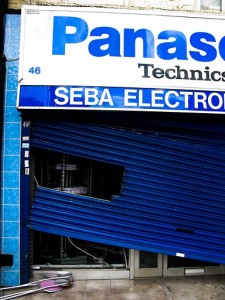
New monthly cheese subscription service launched for Ealing residents

When I took a break from being on the WEN Abundance stall at the Hanwell Carnival on Saturday I wandered over to visit the W7 Emporium stall. W7 Emporium has been set up by Hanwell resident Claire Rosser and is a brilliantly simple idea. She offers a monthly cheese subscrption service whereby for £24 a month she will deliver a carefully sourced and selected range of British and international cheeses. For your £24 you get 1kg of cheeses, often award-winning, which you’re not likely to find in your local supermarket.

I bought five cheeses from her at the Carnival and we had a tasting last night,  and they were all good. Some deliciously strong cheddars, a tangy ewes milk cheese and a very creamy Shropshire Blue amongst them. She will deliver to the W7, W13 and W5 areas on the last Friday of each month.

I’m about to fill out my subscription form and you can find out more details by emailing w7emporium@gmail.com or call Claire on 07828 971200.

I’ll update this post after we get our first delivery.

David Highton

Very enjoyable history of modern art talk last night at OPEN Ealing

I went to second in a series of history of modern art talks last night at OPEN Ealing. Admittedly, the  talks are given by an artist friend of mine Nick Pearson but he’s always been a good talker and I really enjoyed hearing about the radical impact of the Impressionists and Post Impressionists and how they were rubbished by the press at the time in much the same way as modern artists now.

I’d never realised the impact of Japan on 19th century art and how the influence was initially through some goods imported from the newly opened up Japan being wrapped up in copies of prints by Japanese artists. It’s odd how seemingly trivial things can end up having an enormous influence.  Japanese art was very different to Western art. It was more stylised and, for example, whilst Western art would have its main subject clearly visible and obvious, Japanese art might have its subject, such as Mount Fuji, almost tucked away discreetly in the distance.

I also enjoyed hearing that Constable’s painting The Haywain, which is now used on biscuit tins and goodness knows what else, was one of the most radical paintings of its time. It caused a sensation in Paris when exhibited in 1824 and was praised for its honest depiction of a contemporary rural scene. And it had a major influence on artists and contributed to the birth of Impressionism.  Strange how what was once a ground-breaking painting of a rural scene can a century or so later become almost a cliche of a romantic rural idyll.

The talks (12 in total) will take us up to the ‘Young British Artists’ of the late 20th century so there’s lots to go yet. They are every Thursday evening from 7-9pm at OPEN Ealing (113 Uxbridge Road) and cost £7.50 each. So you can always dip in and out if there’s something you particularly want to hear about.

David Highton

The history of Northfields station


Northfield Avenue in 1903 with a cart going south towards the bridge over the railway line

In his second post on local history David Shailes gives a brief history of  Northfields station.

The stretch of line from Acton Town (then called Mill Hill Park) to Hounslow was opened in 1883 by the Hounslow and Metropolitan Railway. The motivation behind its opening was property speculation in the Spring Grove area of Isleworth and the line passed through open countryside. At the time what we know as Northfields was farm land, so no station was provided and the nearest being at South Ealing and Boston Road (Boston Manor).

The line was a sleepy steam-hauled branch line, which was electrified in June 1905 as part of the modernisation of the Metropolitan District Railway (MDR). By the time a station was provided in April 1908 housing development in Northfields had been underway for some time. In 1911 it was renamed Northfields & Little Ealing. The station was on the opposite side of the road to the current station and at platform level the canopies and fixtures were of a similar style to those that remain at Boston Manor today.

By now the MDR was part of the Underground Group (UG) and the District Line with its many branches was becoming severely taxed in terms of line capacity. So the UG resolved to extend the Piccadilly line from Hammersmith to Acton Town and for the Hounslow and South Harrow services to be transferred to the Piccadilly Line. This was funded by a cheap loan provided in 1929 by the Government for the purpose of alleviating unemployment.

Northfields was chosen as the site of a ‘Car Shed’ which required considerable earth moving. Work started in 1931 and the four tracks from Acton Town to Northfields along with the new Northfields Station, in the handsome ‘Adams, Holden & Pearson’ style on its current site, opened in December 1932. Piccadilly Line trains had reached Hounslow West in February 1932 and took over all services (sharing peak hours with the District) in March 1933. As part of further service changes in October 1964 the last District Line train ran to Hounslow West and the line became exclusively used by the Piccadilly services.

David Shailes

Why do people shop in West Ealing? A recent survey gives some answers

‘Why do people shop in West Ealing?’ is the title of a survey late last year of 400 shoppers carried out by Brunel University on behalf of Ealing Council.  The answer – buying food is the main reason people come to shop in West Ealing, but there’s a good deal more valuable information in the results of this survey than  this one answer.

The final report is 20 pages long but here are some of the key findings from this survey:

What’s good about shopping in West Ealing:

1. Buying food was the main reason for people shopping in West Ealing.

2. Buying specific non-food items came second

3. Eating and socialising ranked third as a reason to come to West Ealing

Overall, West Ealing is liked for its varied, multi-cultural location that is good for food shopping, pubs, eating and socialising.

What needs to be improved about shopping in West
Ealing:

1. Better shop fronts

2. Improved cleanliness

3. Better safety and security

Interestingly, in an entry last December in his shopping blog (www.soultsretailview.co.uk/2010/12),  expert retail analyst Graham Soult sees independent shops as West Ealing’s brightest hope. He writes:

‘Arguably, it’s West Ealing’s independent shops that give it the
brightest hope for the future. Walking through, despite the visible problems,
the area has a cosmopolitan and colourful feel, with ethnic food shops
displaying their wares in the street. The West Ealing weekly farmers’ market
in  Leeland Road – which seemed to be well advertised when I visited – also adds to the area’s reputation as a mecca for foodies, and is apparently its trump card in attracting shoppers from other parts of London.’

WEN has been arguing for some years that West Ealing is a great place for food shopping and that we need to build on this strength as a central part of any plan to regenerate the high street. We’d love to hear your views about our shops.  Use our forum to tell us where locally you like to buy your food, why and what you’d recommend others to try out.

David Highton

Origins of some West Ealing street names

Local historian David Shailes writes that when the streets of Ealing were originally laid out the landowners and property developer got to choose the names, so the reasons for their choices are generally not recorded and are lost in the mist of time. Researching street names is interesting for lots of reasons as some have names of local historical interest, others have no local connections and some are linked to events in history.

The length of this article (published in our May newsletter) means that we can only scratch the surface of the 200 odd roads that have a W13 post code.

A set of my personal favourites are the Australian named roads: Adelaide Road, Brisbane Road, Sydney Road and Melbourne Avenue and these were all on land developed by the Steel family and it is known that Charles Steel whose market garden at one stage made him the largest rate payer in Ealing, went to Australia to see how they did things down under. So this may be the reason they have such names.

Loveday Road takes it name from William Lockyer Loveday, who owned land in Ealing, but lived in Devon, which he left in 1860 to start a new life in the State of Illinos in the USA. His son eventually became the owner of what was called the Loveday Estates and these were sold in 1896 for £60,000, a considerable sum of money. The St Kilda and Marder Estates, have also given their names to two roads.

Horticulture gave us Leeland Road andTerrace, as these stand on part of the land that once was part of Charles Lee & son’s Ealing nursery, they had other nurseries in Hammersmith (The Olympia Exhibition hall stands on the site), Feltham, Isleworth and Hounslow. They used the site to grow fruit trees, roses and shrubs.

As a child I lived in Green Avenue and never gave the street name a second thought as there are no other streets named after colours nearby. It appears that the name relates to a H.C. Green who was the very first mayor of the Borough of Ealing in 1901/2. Next to this road is Cranmer Avenue that runs up to St Paul’s Church and on the opposite side is Ridley Avenue, which take their names from two Protestant Martyrs burnt at the stake by Mary Tudor (Queen 1553 to 1558).

The 1777 parish map reveals that North Field Lane (now Northfield Avenue) and Mattock Lane have been with us for over 200 years. My mother who lived in Ealing right up until her death in 1983 always referred to going shopping as up the “lane” meaning Northfield Avenue. Drayton Green existed as a small community on this map, which gave its names to several nearby roads.

Green Man Lane took its name from an old coaching inn on the Uxbridge Road, the second world war damaged pub being rebuilt in the 1950’s was demolished in 1981 and replaced by the block which Iceland is now in. The inn existed on the 1777 map and was an important stabling facility for over 100 horses on the London to Oxford road and on further west to Fishguard  (No A40 in those days!).

(to be continued)

David Shailes

There are more articles about West Ealing’s history in our bi-monthly newsletters. You will get these automatically emailed to you if you become a member of WEN. It’s free to join and details of how to join are on our website. Or visit our website and you’ll find links to the last few newsletters on our home page – www.westealingneighbours.org.uk


West Ealing – hub for car accessory shops

It hadn’t occurred to me until Desire Motorsport opened last week (where Hewden Tool Hire used to be) that this end of West Ealing near the junction with Eccleston Road has a cluster of tyre and car accessory shops. There’s Ealing Tyres in Eccleston Road itself, Kieran’s tyre, MOT and accessory shop in the Uxbridge Road, Kwik-Fit on the corner of the Uxbridge Road and Coldershaw Road, Cartronic Centre in Coldershaw Road and now Desire Motorsport tyre and alloy wheel hub shop has joined them.

I spoke to the owner of Desire Motorsport who lives in Hanwell and has worked locally for many years. He realised the value of being part of a cluster of car-related shops.

Good luck to him and I hope all these shops and businesses, and West Ealing, benefit from being near one another.

David Highton

Newly opened Desite Motorsport joins the cluster of car tyre and accessory shops in West Ealing

Duck waiting patiently outside Sainsbury’s

Just as I came out of Sainsbury’s this morning I heard this quacking noise and there waiting patiently near the front door was a Mallard duck.  Maybe its mate had gone in to shop!  After a while it gave up waiting, quacked loudly and flew off.

That’s by no means the first time I’ve seen ducks around that area. I’ve seen and heard them walking the streets around Melbourne Ave and St James Ave a few times over the last couple of years. I do wonder where they come from? Maybe they are based in one of the ponds at Walpole Park and come to visit West Ealing a few times each year.

If anyone else sees them please do let us know.

David Highton

West Ealing Arts launches its first adult art classes

The community arts project OPEN Ealing, run by West Ealing Arts, has launched its first arts classes and workshops for adults:

  • Watercolour painting on Tuesday mornings and afternoons
  • History of 20th century art on Thursday evenings from 2nd June
  • Silk painting on Saturday afternoons from June
  • Life drawing soon to start on Wednesday evenings

For details of times and costs  visit www.openealing.com or call on 020 8579 5558 or drop in at 113 Uxbridge Road on corner of Culmington Road and opposite fire station).

David Highton


The changing face of our high street

Pamela Howard School of Dance: One of the new shops on our high street

The recent opening of the British Heart Foundation’s new shop (see previous post) made me think again about the changing nature of our high street. Yes, you could just say it’s yet another charity shop and we already have eight. But, it struck me that this shop is something rather different for West Ealing. Almost every time I go in to one of the charity shops it seems busy as I try to manoeuvre my way between the shoppers and the clothes rails. What BHF seem to have noticed though is that there is a complete gap in the market for a charity shop selling household goods such as electrical appliances and furniture.

Much has been written about how Britain’s high streets are changing. I
have lived in West Ealing since 1978 and, like many others, can all too easily reminisce about how West Ealing’s high street used to have a Marks and Spencer, a WH Smith, Mothercare, let alone the department stores such as FH Rowse and Daniels. But that time has gone and in the last few years the twin impact of the recession and the growth of internet shopping have undoubtedly left their mark as shops have moved out or closed down. In a recent article in the Financial Times Liz Peace, chief executive of the British Property Federation, said ‘Given the structural nature of these changes
there is no point harking back to the old high streets we all claimed to love. We need to be creative in looking for new roles and uses for these empty shops.”

I think BHF has been creative. We have seen new shops move in and  Lidl and Poundworld are now part of our high street. They have been joined by some rather different businesses – British Immigration Solutions and The Pamela Howard School of Dance. West Ealing Arts has opened a community arts project in an old office building a short walk away from the main shopping centre (see later article). The London Residents Forum is hoping to open the old Oxfam shop as a borough-wide resource and drop in centre for tenants.

Yes, our high street is changing, it has to, but I see these changes as a sign that the high street still has a purpose for our community. It is still trying providing goods and services that we need and want. Please let’s just make sure we cherish and use our high street and other local shopping areas.

David Highton