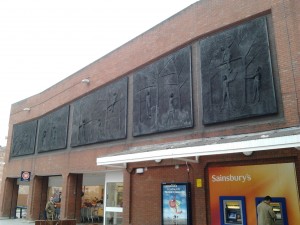
What’s the story of the murals on the front of Sainsbury’s?

Anyone know about this mural?

Chair of WEN, David Highton examines the history of some interesting artwork in the centre of West Ealing

When we first moved here in 1978 there was a small Sainsbury’s in the Uxbridge Road not far from the current one. And I well remember this Sainsbury’s being built on the site of what used to be the library but I can’t for the life of me remember or find out anything about the five panels on the front of the shop. I’ve been to the Central Library and looked through back copies of the Ealing Gazette. I’ve even tried ploughing through pages of Council meeting minutes of the early 1980s but nowhere can I find any reference to these panels and who the artist was.

Sadly, it’s all too easy to forget these panels even exist as they seem poorly maintained. They all show children playing but much of the detail is now hard to see. It’s such a shame for them to go unnoticed. Does anyone know anything about them?

David Highton

Hair and Beauty shop taking over old Richer Sounds site

Chair of WEN, David Highton reports on developments on West Ealing’s high street.

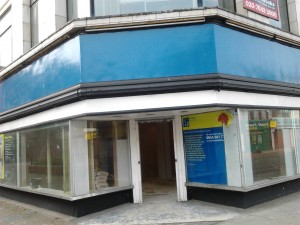
The owners of Farah Hair and Beauty who sold their shop on the Uxbridge Road a few doors along have taken the lease on the old Richer Sounds shop on the corner of the Uxbridge Road and St James Avenue. I bumped in to the husband of the couple that ran Farah and he is hoping they can open up their new salon in about another three weeks once the fit out is finished.

Catalyst Housing Association owns this site along with a number of key blocks of homes locally.  WEN and then West Ealing Arts tried to secure this shop for its community shop idea but, mainly due to the cost of refurbishment, it all fell through.
That corner desperately needs revitalising and we wish them all the best and hope to see them make it a thriving business. Oh, and I’d still like to see a coffee shop and tables in that bit of St James Avenue.


David Highton

West Ealing’s independent shops give hope for the future

Chair of WEN, David Highton has spotted an interesting blog on shopping in West Ealing.

A shopping blog by North East retail expert Graham Soult finds hope for West Ealing’s shopping centre in its food and independent traders.

He writes:

Even before the loss of Woolworths, West Ealing’s high street had seen significant change in recent decades, with the departure of Marks & Spencer in the late 1990s widely seen as an important loss. That site, next to the old Woolworths building, has subsequently been redeveloped and is now occupied by Wilkinson.

Nevertheless, it would be wrong to see West Ealing as a retail centre in terminal decline. It’s true that on my walk along Uxbridge Road and Broadway I noted a lot of vacant shops – including the ubiquitous closed-down Ethel Austin – and cheap-looking discount stores. However, there are plenty of bright spots.

Arguably, it’s West Ealing’s independent shops that give it the brightest hope for the future. Walking through, despite the visible problems, the area has a cosmopolitan and colourful feel, with ethnic food shops displaying their wares in the street. The West Ealing weekly farmers’ market in Leeland Road – which seemed to be well advertised when I visited – also adds to the area’s reputation as a mecca for foodies, and is apparently its trump card in attracting shoppers from other parts of London.

Continue reading “West Ealing’s independent shops give hope for the future”

21 storey tower set to dominate West Ealing centre skyline

Vice Chair of WEN Eric Leach reports on a new development in West Ealing.

Just 12 months after National Government said ‘No’ to a 26 storey residential building overlooking Haven Green, plans have been submitted for a 21 storey residential building which will overlook Walpole Park.

The plan is to demolish the old Westel/TVU mini-Centre Point lookalike building on the corner of Craven Road and the Uxbridge Road on the eastern borders of West Ealing. In its place is planned to build three new buildings – a hotel, a flats for sale block and an Affordable Rents flat block.

Continue reading “21 storey tower set to dominate West Ealing centre skyline”

WEN public meeting – What future for West Ealing? Monday 22nd November, Dean Hall, 7.30pm

It may sound dull but the Council’s current consultation over the Local Development Framework, which is the basis for planning the future of Ealing from 2011 to 2026, will affect all of us and have a profound impact on the future of West Ealing. For example, the plans show:

  • Shops and businesses along the Uxbridge Road corridor demolished to make way for some 1,245 new homes and 3,500 new residents
  • But the plans do not mention how the infrastructure will be put in place to cope with this increase in population:
  • No plans for new schools
  • No plans for new healthcare facilities
  • No alternative strategies to ‘densifying’ the housing along the Uxbridge Road corridor

Because we feel it is so important that as many residents as possible have the chance to hear about and comment upon  the Council’s plans for West Ealing from 2011-2026, we have organized a public meeting. The meeting will take place at 7:30pm on Monday 22nd November, 2010. It will be held at Dean Hall on Singapore Road.

At this meeting West Ealing Neighbours will provide an overview on how future plans for Ealing will directly affect West Ealing. Specific Council policies to be discussed include proposed developments in West Ealing centre including extensive building of blocks of flats, and 50 or more shop demolitions. The meeting will also discuss what is missing in the plans – including the lack of new educational and healthcare facilities to support the 3,500 new residents in the 1,245 new homes. Attendees will also be shown how to register their objections to the plans.

At this meeting West Ealing Neighbours will provide an overview on how future plans for Ealing will directly affect West Ealing. Specific Council policies to be discussed include proposed developments in West Ealing centre including extensive building of blocks of flats, and 50 or more shop demolitions. The meeting will also discuss what is missing in the plans – including the lack of new educational and healthcare facilities to support the 3,500 new residents in the 1,245 new homes. Attendees will also be shown how to register their objections to the plans.

Please come along and make your views on West Ealing’s future heard

Ealing Council’s Future of Ealing Meeting Discusses Quality of Life Issues

Vice Chair of West Ealing Neighbours, Eric Leach, looks at how Ealing Council is proposing to provide for services to 2026, and finds much to be lacking, especially in terms of community infrastructure.

In the real world residents are interested in being happy, safe, healthy and fulfilled. If they are parents they want their children to receive a good  education. In terms of land use, meeting these needs requires designating ‘preferred use’ on land to be used for providing a whole range of services. Top of the list for these services is the need to provide adequate facilities for maintaining law and order, healing the sick and teaching our children. Also on the list are open space, transport, play, cultural and sporting needs.

On Wednesday 13th October 2010, Ealing Council convened a public meeting to explain how it was going to allocate ‘preferred land use’ for these purposes over the next 15 years.

Ealing Council’s home building plans over this period include introducing over 20,000 new residents into the so-called Uxbridge Road Corridor (Southall to Acton). The Council’s plans for home building are very specific. For example in the centre of West Ealing 18 sites are identified for building 1,245 new homes. The vast proportion of sites involve demolition of existing buildings. However the plans to build new Police Stations, healthcare centres or schools along this corridor are very vague. In West Ealing centre for example no specific sites are identified to provide these additional facilities to support the new 3,000+ residents.

As many residents at the meeting pointed out, the Uxbridge Road corridor is heavily developed. Consequently there is no space to build these new ‘infrastructure’ facilities. The Council does not suggest demolishing existing buildings to provide space for schools, healthcare or Policing centres.

The provision for Primary education in West Ealing (2011 – 2026) I found especially worrying. There are only two State Primary Schools in West Ealing centre – St John’s and Drayton Green. There is no realistic scope for expanding these schools unless they are rebuilt as educational tower blocks. In the south of West Ealing, Fielding Primary has already been expanded to a staggering 870 children (by building on the playing field). Hathaway Primary in the north has a playing field that could be built on (presumably) but no plans exist to extend Hathaway. All very strange. There is some vague commitment to search for a new Primary School site in central Ealing. Given that we are now in year 6 of this formal planning process the commitment to ‘searching’ is really not that impressive.

No preferred land use details exist at for all for any cultural infrastructure in the whole of Ealing.

There is no commitment to building an integrated transport hub around Ealing Broadway Station.

UK Planning Law is clearly not helpful to residents or Councils in the provision of infrastructure. Money for infrastructure is apparently to be found by collecting up the financial crumbs from the rich property man’s table. The latter is either a rich Housing Association (eg A2Dominion) or a private property development company (eg St George). Apparently there are never anywhere near enough crumbs to make any kind of infrastructure ‘meal’. Ealing Council’s track record in enforcing these crumb collection exercises (S106/Planning Gain) appears to be very poor.

Formally the meeting was reviewing the document ‘Ealing 2026: Infrastructure Delivery Plan: September 2010: Ealing Regeneration & Housing’. This document is part of Ealing Council’s ‘Evidence’ to support its Local Development Framework proposals.

Only 25 people turned up to this meeting. This included two Conservative Councillors but no Labour Councillors. No senior Planning or Economic Regeneration Officers bothered to turn up. The meeting was held in a little known, difficult to find community centre in the daunting South Acton Estate.

West Ealing is in dire need of a cinema: a pop up cinema would be a great addition to our community

Allison Franklin and Chris Gilson look at the possibilities of having a pop up cinema in West Ealing.

Pop up shops and restaurant are common in London nowadays: an empty retail unit is taken over for a few weeks with minimal fittings and then it’s gone. This concept has now extended to cinemas; films are being shown in places as diverse as old railway tunnels, under motorway flyovers and even abandoned petrol stations.

There are thousands of square feet of unused office space along the Uxbridge Road. This space could be easily used as a pop up cinema. A pop up cinema would need:

  • empty available indoor space. There’s plenty of that locally
  • a licence to show films
  • some comfy furniture (sourced via Freecycle) or people could bring their own
  • basic catering
  • tickets (Rymans. Sorted.)

Pop up cinemas are very attractive as they will provide a way for people to get together and meet their neighbours and other locals, and not break the bank going to the pictures.

What do you think? Let us know in the comments section below.

If you’re interested in helping out with starting a pop up cinema in West Ealing, pop us an email.

West Ealing Family Day 23 October

West Ealing Neighbours, local businesses and traders and the Council have joined together to put on the first ever West Ealing Family Day. Across the centre of West Ealing in Leeland Road, Melbourne Avenue and St James Avenue we will be putting on a series of events and activities for all the family.  The three streets will be differently themed:

Leeland Road will have a specially extended farmers’ market with apples as a theme (it’s Apple Day on October 21st). There will be an exhibition of over 100 rare and different varieties of apple, cider tasting, apple and spoon racing and an apple juicing demonstration

Melbourne Avenue will be for food and entertainment with a stage set up for a variety of local music and dance events as well as children’s entertainment and food stalls

St James Avenue is all about what people local people are producing, whether its crafts or artworks, and will play host to the first ever street craft market in West Ealing.  WEN’s Abundance team will be busy making apple and pear juice all pressed from locally picked fruit and St James Church will house an art exhibition by the Brent Lodge Park Arts Collective  – a collective of artists with and without learning difficulties.  The church will also open its cafe where you can put your feet up and try locally made cakes and sandwiches.

Click here to leave a comment.

What Will Ealing Be Like in 2026?

Vice-Chair of West Ealing Neighbours, Eric Leach looks at the future options for Ealing and the Council’s role.

This was the title of a public meeting convened by Ealing Council in Ealing Town Hall on Tuesday 21 September, 2010. Over 100 residents attended the meeting which was very well chaired by Bob Gurd, Chair of Ealing Civic Society.

The meeting was the first of a series of Ealing Council events in September, October and November at which the Council will describe its plans for how Ealing’s land will be used over the next 15 years. These plans are variously available for review on the Council’s web site, in Council Libraries and in Perceval House. The formal Public Consultation period began on 17 September and will end on 30 November, 2010. In formal Town Planning jargon these local plans make up Ealing’s Local Development Framework (LDF).

The elephant in the room was that the ‘new’ plans are very much like the ‘old’ plans presented to residents in 2009. 14,000 nw homes will be built with 78 % of these (10,000+) being built within 800 metres of Southall, West Ealing, Ealing Broadway and Acton railway stations. Many attendees expressed dissatisfaction with these plans – as they had done in 2009.

In 2009 it was planned to build 1,900 new homes in the centre of Ealing – now (inexplicably) that figure has grown to 2,600. Three new hotels are currently being built in the centre of Ealing and the proposals revealed plans to allow another six hotels to be built.

100 sites for development are identified in the proposals. Another 32 development sites have been identified but as yet have not been documented in the proposals. This surprised one attendee who described this as over-development and emphasised that Ealing is already a developed community. Further echoes of the 2009 Consultation were heard when attendees expressed unhappiness at the poorly documented infrastructure provisions especially those for education. The proposals quoted the ex-Labour Government’s ‘Building Schools for The Future’ plans for Ealing – which of course have been recently slashed for most Ealing schools.

Of course we all broke up into 10 people study groups – just as we had done in the 2007 and 2009 LDF Public Consultations. Transport concerns stressed transforming Ealing Broadway Station (EBS) into a genuine integrated transport hub (not in the plans) and had the Council really got its figures right for adequate capacity for traffic in and out; within; and parking in Ealing. On the homes and jobs front residents saw 90,000 sq metres of new office space in the centre of Ealing as an over-provision – especially as so much office space is currently empty. Why asked one resident is there so little planned residential growth in Greenford and Northolt whilst so much residential growth is planned for the already more densely populated area of central Ealing, Acton, West Ealing and Southall? Why, asked another, are Ealing’s housing targets so much higher that many other comparable London boroughs? 50,000 sq metres of new retail are planned for the centre of Ealing. Will this space ever be filled was a question which was not answered with any sort of conviction.

Options were described for improving the arrangement of buses around Haven Green. It was made clear that very little money could be found to do this and that the idea of a fully functioning bus station or an integrated transport hub in the centre of Ealing was out of the question. This approach, when seen against the backdrop of the £billions of somebody’s money to be spent on the 100 development sites throughout Ealing over the next 15 years, is truly shocking.

To the surprise of many, four new options for developing the Arcadia site were presented in a full colour leaflet courtesy of consultants Tibbalds. Sadly it appeared that these designs bore little relationship with the sparse revamping plans for EBS just across the roads from Arcadia.

A tall Buildings Policy was alluded to but not quantified!

Ealing Council Officers found no time during the three hour meeting to mention anything about use of land for healthcare, law and order, sporting, cultural, the exploding elderly population, and community centres. No mention was made of alternative plans which had been rejected and why they had been rejected.

More than one resident questioned whether the Council would listen to residents’ concerns and ideas and reminded all those in the room that residents’ feedback in the 2007 and 2009 LDF Public Consultations had been studiously ignored.

Another startling revelation at the meeting was that in order to have your own copies of the four key documents (674 pages in total) you’ll have to pay Ealing Council £55 to acquire one copy of each. However those rich enough to shell out this kind of money will have to wait until at least Thursday for copies to be available from the printers.

In his concluding address Steve Barton, Ealing Council’s LDF supremo, described in some detail the ‘Test of Soundness’ which the Government’s Planning Inspectorate would apply to Ealing’s final LDF submission. What was painfully absent from this shopping list of tests was any notion of acceptance of the plans by Ealing’s 250,000 adult population. This appalling own goal can be seen as both a local and national disaster.

Finally Council Leader Councillor Julian Bell attended most of the meeting. This was encouraging as he has personal responsibility at Cabinet level for the LDF. However Mr Pat Hayes who is Ealing Council’s salaried Regeneration supremo and the Director driving this over-development was glaringly absent from the meeting.